
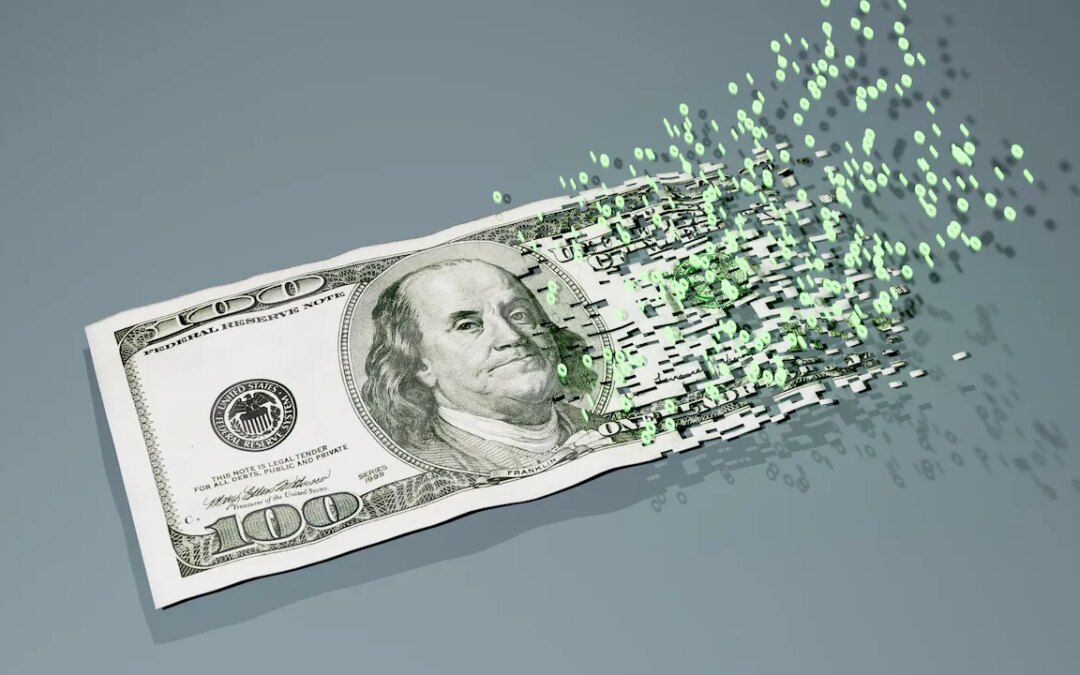
Predictions of a cashless world have circulated for decades, yet physical money continues to anchor daily commerce across much of the globe.
Visa’s 2026 outlook highlighted just how large that footprint remains. The company estimated that roughly $11 trillion in cash is still in circulation worldwide.
“Paper money is not going to disappear any time soon since there is just so much of it still around the globe,” Visa Group President Oliver Jenkyn said in the outlook, citing the $11 trillion estimate. “And this will fuel innovation and growth in digital payments in many countries for years to come.”
“However, the global cash curve is bending,” Jenkyn said, adding that “2026 will be the first year in history when half of the world’s total consumer payments are made with card credentials.”
That $11 trillion still in play offers a wide berth for a continuance of trends that PYMNTS Intelligence has explored over the past several months, underscoring Visa’s outlook for credentials and digital options.
Cash remains deeply woven into informal economies, small-value transactions and regions where banking access is limited or uneven, paving the way for digital channels. Even in advanced economies, consumers often turn to cash for budgeting, privacy or when digital options introduce friction.
Advertisement: Scroll to Continue
The decline is not abrupt, as Visa showed, but the direction is clear as digital alternatives increasingly outperform physical money on speed, convenience and acceptance.
Digital Payments Are Chipping Away at Cash
PYMNTS Intelligence data in the “How the World Does Digital” series showed that consumers are not abandoning traditional funding sources like debit and credit cards. Instead, they are changing how they access them. Mobile wallets now account for 35% of online transactions and 21% of in-store transactions across 11 major economies studied by PYMNTS.
The shift reflects a form-factor change rather than a wholesale change in payment preference. Phones, not plastic or banknotes, are becoming the primary interface for spending. As that transition accelerates, cash is increasingly sidelined, particularly among consumers who are deeply embedded in connected technology ecosystems.
Faster Payments Are Reducing Cash Dependence
In emerging markets, faster payment rails are proving especially effective at reducing reliance on cash. Brazil’s Pix system has transformed everyday payments by enabling instant, low-cost account-to-account transfers that function as a practical substitute for physical money.
India’s Unified Payments Interface has followed a similar path, scaling digital payments by making transfers immediate, inexpensive and widely accepted, even among small merchants and informal sellers. These systems succeed because they address the core reasons consumers use cash in the first place, including immediacy, simplicity and universal acceptance. When digital payments replicate those attributes, cash loses its advantage.
Why Consumers Are Choosing Digital
Consumers are moving away from cash for practical reasons. Convenience is central. Mobile wallets reduce checkout friction through tap-to-pay or scan-based interactions. Speed also matters, especially as real-time payments make funds available instantly.
Security remains a concern, but one that is increasingly being addressed. Many consumers historically viewed cash as safer because it could not be hacked. Today, digital payments rely on tokenization, biometric authentication and device-level security, shifting protection from something consumers manage themselves to something built into the transaction.
Cash Decline Is Uneven but Directional
The decline of cash varies by region and demographic.
The PYMNTS Intelligence report “How People Pay: Consumer Preference For Connected Technology” found that cash usage continues to decline, but unevenly across consumer segments. Consumers most embedded in connected technology ecosystems are leading the move away from physical money. Connected-tech consumers are now 34% less likely to use cash than they were three years ago, and 60% reported not using any physical form of money in the 30 days before being surveyed.
By contrast, consumers with fewer connected devices continue to rely on cash more frequently, underscoring that cash use is closely tied to access, familiarity and comfort with digital tools rather than income alone. The data suggested that as consumers adopt more connected devices and digital payment interfaces, cash becomes less central to everyday spending.
The $11 trillion in cash still circulating globally highlights how much ground remains. Yet PYMNTS Intelligence data shows that the trajectory is unmistakable. Digital payments are gaining share not because cash is disappearing, but because digital options increasingly deliver what consumers want.